
Introduction: How Has the Eastern Folding Fan Entered the Western Cultural Imagination?
Originating in China and later transmitted through Japanese and Korean cultures, the handheld folding fan became more than a simple cooling device upon entering the Western context. Since the 18th century, the folding fan in Europe has been imbued with a new aesthetic language and cultural symbolism, transforming into a signifier of female identity, social etiquette, and even power. In contemporary fashion and performing arts, the folding fan has undergone another round of cultural reconstruction—it is not just an accessory but a means of expression, a tool, and a powerful symbol. This article focuses on the cultural keywords “mystery” and “power,” exploring how the folding fan has evolved on Western stages into a deeply meaningful cultural medium.
The Imagery of “Mystery”: Concealment, Suggestion, and the Art of Seduction in Performance
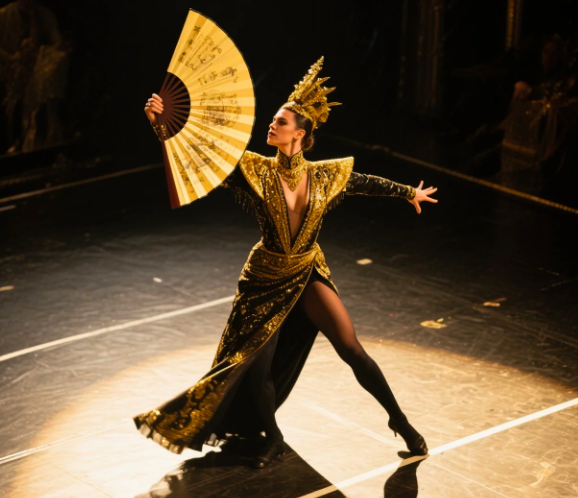
As an object capable of opening, covering, and highlighting, the dynamic structure of the folding fan lends itself well to shaping an aura of mystique in Western arts. In the 19th-century French and British social circles, the folding fan became a tool for non-verbal communication among women. This symbolic tradition was later integrated into stage performances, particularly in ballet, opera, and modern theatrical productions, where the fan became an extension of bodily expression, enhancing character depth and the rhythm of visual storytelling. Examples include:
- In French cabaret and burlesque, large feather fans—though structurally different from Eastern folding fans—share a similar symbolic logic, concealing and revealing at will to heighten the tension between seeing and being seen.
- In modern fashion shows, folding fans are often designed as hybrid accessories, combining the functions of veils and handheld props. The dramatic act of opening or closing the fan accentuates the themes of awe and aloofness, constructing a heightened theatrical presence.
This reinterpretation of mystery redefines femininity not as passive but as actively commanding attention and controlling narrative through symbolic reconstruction.
The Fan as a Metaphor for “Power”: From Courtly Status to Markers of Influence
In Western society, the association between fans and power originated in royal courts, particularly in Spanish and British aristocracy, where folding fans were indispensable symbols for queens, princesses, and noblewomen. Not all women were permitted to carry fans—their size, number of ribs, and decorative elements directly reflected social status and economic privilege.
This power symbolism extended into artistic representation:
- In 18th-century French court paintings, women holding folding fans were often depicted as figures wielding social influence and emotional control.
- In Shakespearean stage adaptations, female protagonists such as Lady Macbeth and Cleopatra were often portrayed with folding fans, signaling their manipulation of events or crafting of illusions.
- In modern films and fashion editorials, such as Moulin Rouge, The Great Gatsby, and Anna Karenina, folding fans serve as both styling tools and metaphors for power, highlighting an understated presence of female authority.
This cultural code continues to be redefined in pop culture: contemporary designers often enlarge the fan’s dimensions and incorporate metal, mirrored surfaces, and neon hues to intensify its visual prominence and symbolic strength, simultaneously amplifying its presence and asserting cultural identity.
The Continuation and Innovation of Folding Fans in Modern Design and Performance
Modern folding fan design in the West is undergoing a transformation—a reinvention of Eastern aesthetics through Western reinterpretation:
- Leading fashion houses like Alexander McQueen, Jean Paul Gaultier, and Guo Pei incorporate folding fan elements into haute couture, utilizing their architectural structure to enhance the sculptural impact of garments.
- In stage design, folding fans are no longer mere props but integral spatial elements—from suspended giant fan installations to mirror-paneled fan walls, merging costume, performance, lighting, and sound into multi-dimensional visual environments.
- In music videos and contemporary art, performers such as Lady Gaga, Beyoncé, and Rihanna use folding fans as statement accessories and choreographic tools, reinforcing their symbolic association with fiery allure and cool sophistication on a global stage.
These innovations ensure that folding fans are no longer viewed as relics of the past but as highly charged cultural mediums for the future.
Craftshistory’s Cultural Dialogue: Infusing Cross-Cultural Design with Craftsmanship
Craftshistory recognizes the varied symbolic energy of folding fans across cultural contexts and actively promotes the fusion of Eastern and Western design languages in international collaborations:
- Customized designs tailored for stage performances, editorial shoots, and installation art.
- Material and structural flexibility to support mystery, power, and identity-driven creative concepts.
- Each custom folding fan comes with traceable craftsmanship details and production notes, ensuring that users appreciate its cultural significance beyond visual appeal.
Craftshistory believes that folding fans are not static museum pieces but design artifacts imbued with emotion, presence, and cultural intent.
Conclusion: The Multifaceted Expression of Folding Fans in a Global Context
The reinterpretation of mystery and power through folding fans on Western stages has enriched its cultural identity while expanding its artistic potential. From Asia to Europe, from scholarly desks to spotlighted performances, the folding fan continuously tells evolving stories of identity, allure, and strength. Craftshistory remains dedicated to this cross-cultural conversation, ensuring that every unfolding fan silhouette continues to script the elegance of its era.